

why do we romanticize suffering?
notes on the performance of grief and the horror of being ordinary

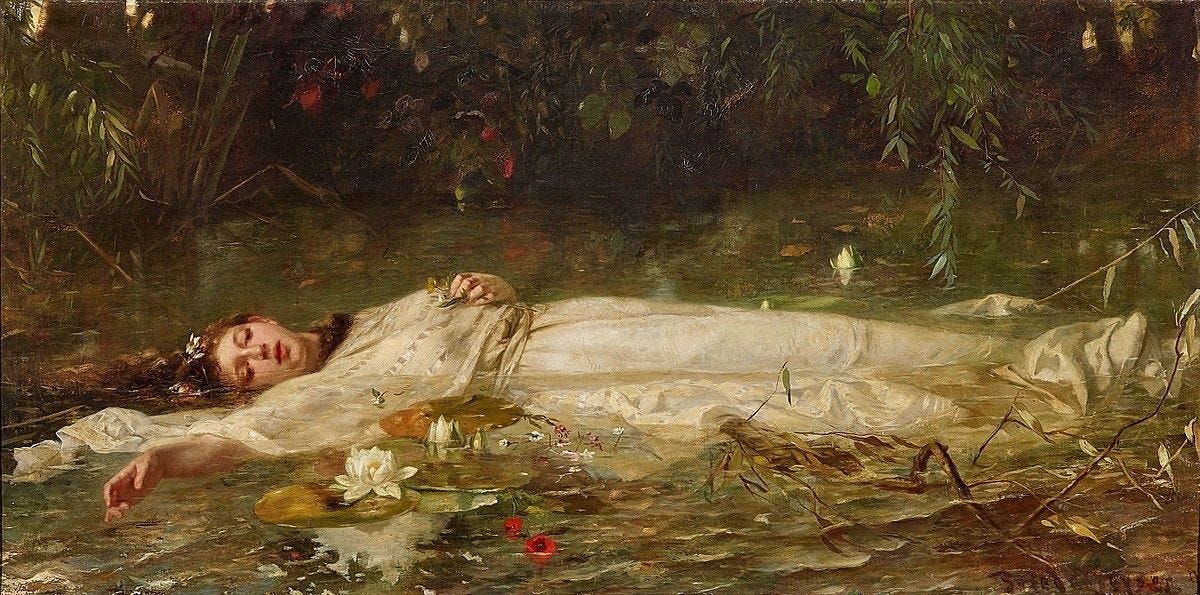
The cold kitchen floor digs into the flesh of my bare thighs. I sob against the pale furniture and wait for its touch to warm my shattered heart. Each sob fades into a murmur that tries to convince me that this is my so-called character development and that I should be grateful because it has made me the person I am today.
A nearly nonexistent part of me that tries to break through from within whispers that going through hell isn’t a prerequisite for being someone of value, and that pain is just pain. I stifle that voice and crunch it under my fingers. I try to take deep breaths, but the air burns my throat. I hug my legs and lie completely still.
Instead of listening to it, I just do what I always do. I look for Sylvia Plath. I revisit The Bell Jar, which I’ve read three times already. I skim through a couple of pages and feel an absurd, almost embarrassing relief. I think she would have understood. If she had lived long enough and we had met, she would have looked at me for five minutes and known exactly what to say. My mind starts scheming and gets to the conclusion that no one has ever managed to put into words what I feel like she has.
Then come Anne Sexton, Alejandra Pizarnik, and Virginia Woolf. I accumulate them as if they were a group of imaginary friends waiting for me every night at my bedside table. I convince myself that we belong to the same category of women and that we share some kind of inherited sadness that no one has ever been able to understand. I start reading them looking for comfort and end up looking for proof. Every sentence that even remotely resembles me, I underline with childlike satisfaction. See? I’m like that too.
I begin to think that Esther Greenwood and I share the same sickness of the soul, that our despair has the same texture and also the same importance, despite being so distinct. For a few minutes, I stop feeling like a girl crying on her kitchen floor and become the protagonist in a story where nothing ends well.
On nights when I don’t feel like reading, I sit by the window and let someone else do my thinking for me. I put on my headphones and look for melancholic songs. I listen to them one after another, sometimes repeating the same one more than once, because worsening my mood is a way of giving it the justice it deserves.
I look out the window as the lights of the buildings fade, and for a moment, my life stops seeming like a succession of ordinary events. The music transforms my sadness into a scene. My tears cease to be tears and become part of a carefully crafted sequence. I manage to contemplate my own misery from the outside and find myself imagining how someone else would see me at that moment. I wonder what they would think of me and how much compassion they would feel. I wish that, for once, the severity of my pain would be so evident that no one could ever be able to ignore it.
There are no other losses and no other griefs. Only mine exists. Only mine matters. My suffering expands until it fills the entire room and ends up seeming like the only truly tragic thing that has ever happened.
Only much later do I begin to wonder if I really wanted to stop suffering.
I’ve always felt a strange fascination with my own sadness and everything that comes after I’m left breathless after crying. Also with the idea that all this anguish was expanding some invisible part of me and making me more observant, or interesting. More worthy.
And then I begin to ask myself something I’ve never dared to ask before.
Why do I do this?
Why do I need to convince myself that my pain is making me a better person? Why do I cling to women who wrote from a place of suffering as if their words were proof that mine, too, will one day arrive? Why do I prefer to think that I’m living through a particularly tragic chapter of my life instead of accepting that, perhaps, I’m simply sad?
You romanticize suffering because the alternative is unbearable and, sometimes, even boring. Especially if it lacks a narrative thread. So, to fight it tooth and nail, you invent a purpose for it because it’s terrifying to admit that the anguish that haunts you isn’t always the prelude to an epiphany. You turn it into a myth because, by naming it after Plath or Pizarnik, your pathetic tragedy ceases to be a humiliation and becomes a ritual worthy of admiration.
You’ve built your identity so close to the abyss that stability now seems like a flat desert with no one to call upon at midnight. You’ve told yourself the story of the tragic heroine so many times that the idea of feeling better, as paradoxical as it may be, sounds vulgar.
Hang up the costumes of tragedy. The function is over.
This article was inspired by a note I wrote a few weeks ago. It’s a concept I’ve wanted to explore on several occasions, but I never dared to write as something longer than just a short note.
wow. i was JUST thinking about this recently. sometimes, it feels as if i cannot let my pain just be my pain. it has to be part of some grand process in my becoming, and sometimes i even find myself clinging to it as if i don’t know who i am without it. i find that i have always shrunk with friend groups, struggling to make space for my world too and perhaps that is why i lean into romanticizing it instead. because imagining it as something of importance makes me feel worthy too.
I journaled a few months about something very similar! A personal quote I wrote that I keep till this day with me is “To let yourself feel without thinking”. As you stated, sometimes you just have to accept that you’re sad, not overthink, not say “this is simply just a rough chapter in my life”. Because In reality, in that moment, you’re simply just feeling sad.